
Lesson Plan Template for Preschool
A good preschool lesson plan fits on one page: what children will learn, what they’ll do, what you need and how you’ll notice their progress. This template maker fills that page for you from a theme, with activity ideas for each part of the morning, an automatic materials list and space for observations — then prints it ready for the classroom wall or your planning binder.
- Free to use
- No sign-up
- Runs in your browser
Preschool lesson plan maker
Preschool Lesson Plan Templates
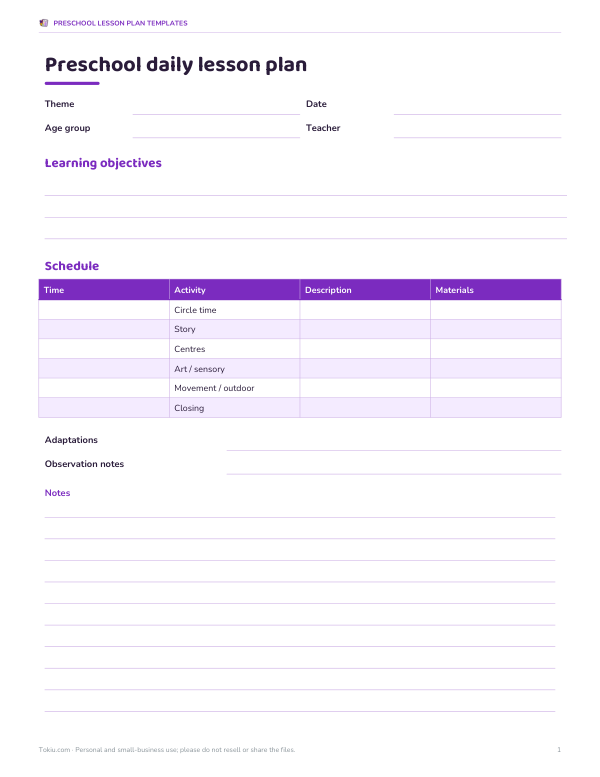
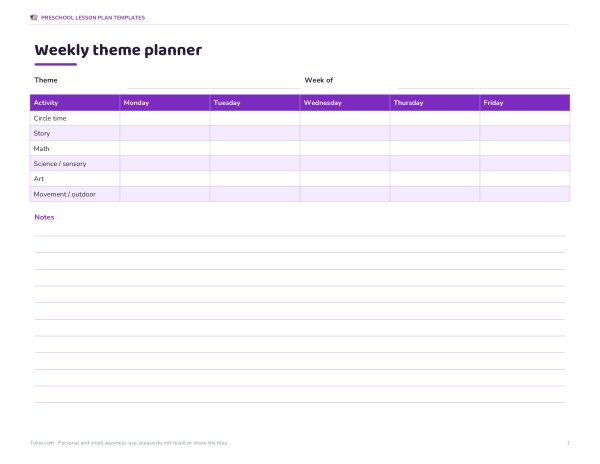
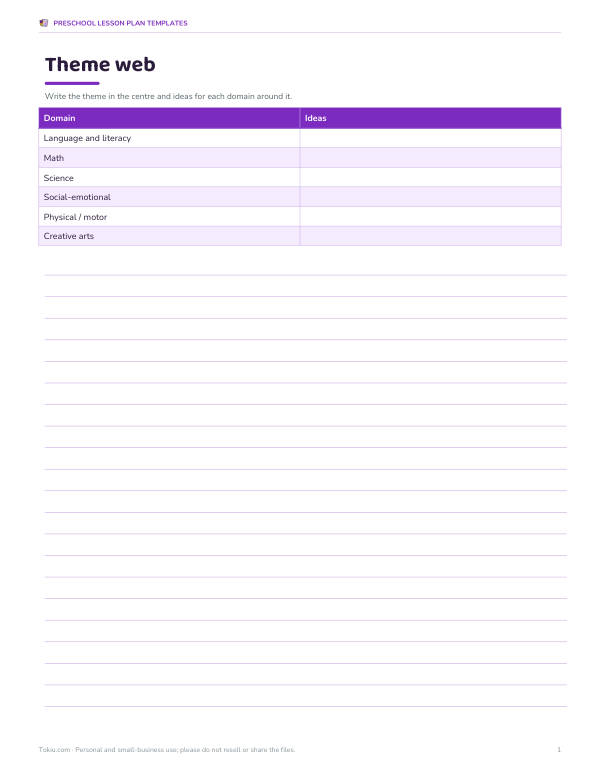
Editable daily preschool lesson plan template, weekly theme planner, theme web page, observation checklist by domain and a materials checklist.
- Daily lesson plan (DOCX/PDF)
- Weekly planner (DOCX/PDF)
- Theme web (PDF)
- Observation checklist (PDF/DOCX)
- Materials checklist (PDF/DOCX)
Formats: DOCX, PDF. Instant download after payment (link valid 72 hours, up to 5 downloads). AI-assisted: the templates were drafted with AI help and reviewed and laid out before publishing.
$3.00 USD, one-time 5 files · about $0.60 each
- Instant download
- 7-day refund
- Secure checkout by Stripe
7-day money-back guarantee. Full refund within 7 days of purchase, even after you download.
Free sample: Daily Lesson Plan Template (PDF, 60 KB)
Full refund within 7 days — see the refund policy and license.
Free printables
Single sheets you can print right now, no sign-up. The full pack adds every sheet in one download plus the editable files.
 Printable Observation Checklist for Preschool
 Printable Preschool Materials Checklist
What a preschool lesson plan includes
| Section | What to write |
|---|---|
| Theme or topic | The big idea for the day or week |
| Learning objectives | Two or three things children should be able to do — observable, like “sort animals by size” |
| Developmental domains | Language, math, science, social-emotional, physical and creative areas the activities support |
| Schedule and activities | Circle time, story, centres, art, sensory play, movement and outdoor time |
| Materials | Everything to prepare in advance |
| Adaptations | Support for children who need it, extensions for those ready for more |
| Observation | What to watch for and record |
Theme activity ideas
| Theme | Objectives | Sample activities |
|---|---|---|
| Farm animals | Name five farm animals and the sounds they make; Sort animals by size; Take turns during group games | circle time: sing “old macdonald” and hold up animal pictures as each verse is sung; story: read a farm picture book; math centre: sort toy animals into big and small barns |
| Weather | Describe today’s weather using weather words; Match clothing to weather; Notice changes over the week | circle time: look out of the window and move the weather chart arrow; story: read a weather picture book and act out the weather with hands and voices; science: make rain in a jar |
| Colours | Name primary colours; Mix two colours to make a new one; Sort objects by colour | circle time: colour hunt; story: read a colour-themed picture book; science: colour mixing with droppers and coloured water in ice-cube trays |
| Community helpers | Name helpers in the community and what they do; Use tools in pretend play; Show kindness and cooperation | circle time: show pictures of helpers — doctor, firefighter, teacher, mail carrier — and talk about how they help; story: read a picture book about community helpers; dramatic play: set up a pretend clinic or post office |
| Seasons: autumn | Describe autumn changes using the senses; Count and compare leaves; Practise cutting and gluing | circle time: pass around real leaves, acorns and pinecones; story: read an autumn picture book; math centre: count leaves into numbered cups 1–10 |
| Ocean | Name ocean animals; Explore float and sink; Describe size using big, bigger, biggest | circle time: ocean animal cards; story: read an ocean picture book; science: float or sink |
Each theme in the maker has six activities covering circle time, story, a learning centre, art, sensory or science play and movement, with a matching materials list.
Timing for young children
Attention spans are short in the early years, so preschool plans alternate calm and active times and keep whole-group activities brief. As a rough guide, many teachers keep circle time to 10–15 minutes for three-year-olds and a little longer for four- and five-year-olds, with longer stretches for free-choice centres. The maker shortens activities automatically for toddlers and adds five-minute transitions between activities — songs, clean-up rhymes or a visual timer help children move between them.
Worked example
A teacher in the Sunflower Room plans a weather day for three- and four-year-olds starting at 9:00 with 20-minute activities. The maker lists three objectives — describing today’s weather, matching clothing to weather and noticing changes over the week — and schedules circle time 9:00–9:20, story 9:25–9:45, the rain-in-a-jar science activity 9:50–10:10 and so on, each followed by a five-minute transition. The materials list reminds the teacher to bring a clear jar, shaving foam and food colouring. The teacher adds a note about one child’s visual schedule and prints the plan for the classroom door.
Writing good objectives
- Use action words you can see or hear: name, sort, count, match, describe, build, take turns.
- Keep them realistic for the age group — one step beyond what children can already do.
- Link each objective to at least one activity.
- Plan how you will notice progress: a quick checklist, photos or short notes.
- Many regions publish early learning standards or frameworks; align your objectives with the one your programme follows.
Inclusion and adaptations
Every group includes children at different stages. Offer choices of materials (chunky crayons and fine markers), pair a confident child with a quieter one, use pictures alongside words for children learning English, and plan a calm corner for children who need a break. Record adaptations in the notes box so any adult covering the class knows what helps.
What’s in the template pack
- Editable daily lesson plan template (Word and PDF)
- Weekly theme planner grid
- Theme web planning page
- Observation checklist by developmental domain
- Materials and preparation checklist
The pack is a one-time download; the plan maker is free to use.
Privacy
Everything you type stays in your browser. Avoid children’s full names on plans that are displayed publicly.
Frequently asked questions
What should a preschool lesson plan include?
A theme, objectives, schedule of activities, materials, adaptations and observation notes.
How long should preschool activities be?
Often 10–20 minutes for whole-group activities, longer for free-choice centres.
How many objectives per day?
Two or three clear, observable objectives are usually enough.
Can I use my own activities?
Yes — untick suggestions and add your own in the notes, or edit the Word template in the pack.
Does it work for toddlers?
Yes — choose the toddler age group to shorten activity times.
Is my data saved?
No. Everything stays in your browser.
Can I plan a whole week?
Print a plan for each day, or use the weekly theme planner in the template pack.